Author: Ashwarya Sharma, Advocate, Co-Founder & Legal Head, RB LawCorp
Published on: 18/08/2026
Introduction
On 10 August 2026, less than nine months after the Hon’ble Supreme Court’s judgment in Madras Bar Association v. Union of India & Anr. (Writ Petition (C) No. 626 and 1018 of 2021) [(2025) 36 Centax 340 (S.C.)], the Lok Sabha passed the Tribunals Reforms Bill, 2026.
The Bill was passed by voice vote amid protests from Opposition members and without a detailed discussion. Yet, irrespective of the manner of its passage, the legislation deserves close attention. It may prove to be one of the most significant attempts to restructure the quasi-judicial administrative hierarchy of India’s justice delivery system.
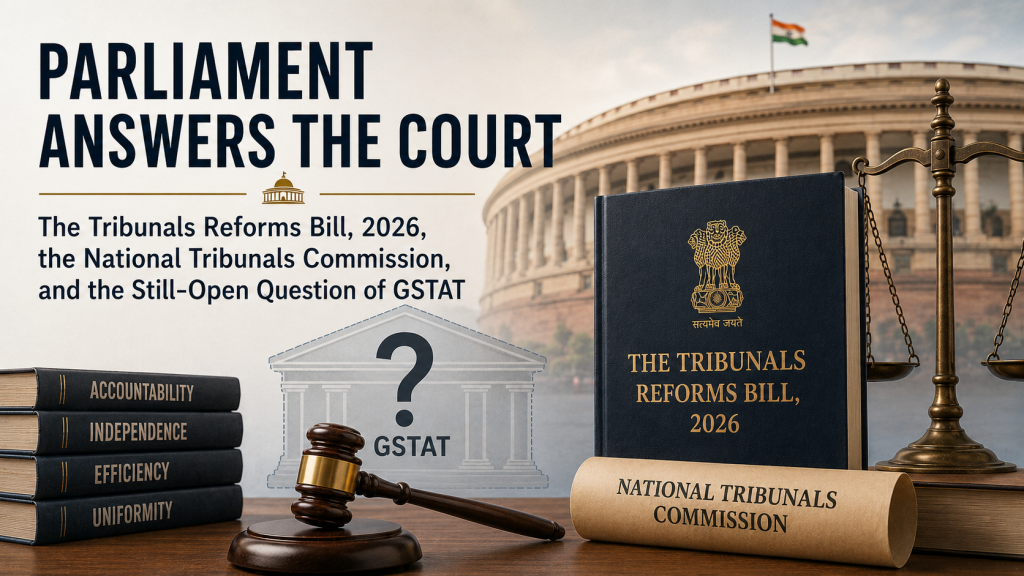
More importantly, it needs to be examined not merely for what it seeks to correct, but also for what it leaves unresolved, particularly in relation to the Goods and Services Tax Appellate Tribunal (GSTAT).
The issue has a long constitutional history, extending from S.P. Sampath Kumar and L. Chandra Kumar to the series of judgments in the Madras Bar Association litigation. The most recent judgment, delivered on 19 November 2025, struck down provisions of the Tribunal Reforms Act, 2021 for reviving provisions that had already been invalidated by the Supreme Court.
The 2026 Bill therefore represents another chapter in India’s continuing experiment with tribunalisation and, most importantly, with the manner in which members of these tribunals are selected, appointed, governed and removed.
I. A Legislative Response, Nine Months in the Making
The present Bill stems directly from the November 2025 judgment in Madras Bar Association, in which the Hon’ble Supreme Court directed the Union Government to constitute a National Tribunal Commission within four months.
The Court had once again identified several structural defects that had repeatedly been struck down in earlier judgments, including:
- A minimum age requirement of 50 years;
- A four-year tenure;
- Two-name panels for appointments;
- Executive-majority selection committees;
- Service conditions aligned with civil servants; and
- Unchecked executive discretion in matters of reappointment.
The Tribunals Reforms Bill, 2026 seeks to address several of these concerns through a common institutional framework.
II. The National Tribunals Commission: Structure and Mandate
Section 3 of the Bill provides for the establishment of the National Tribunals Commission, headquartered in New Delhi.
Its composition consists of:
- One Chairperson;
- Two Judicial Members; and
- Two Technical Members.
Chairperson
The Chairperson must be a Judge of the Supreme Court or a Chief Justice of a High Court.
Judicial Member
A Judicial Member must be a Chief Justice or Judge of a High Court.
Technical Member
A Technical Member must be a person of ability, integrity and standing with at least 25 years of experience in public administration, finance, law, accountancy, banking, management or technology.
The Commission is entrusted with several important functions, including:
- Selecting Chairpersons and Members of the tribunals listed in the First Schedule through Search-cum-Selection Committees;
- Reviewing the performance of Tribunals;
- Overseeing inquiries into complaints against Tribunal Chairpersons and Members; and
- Developing and maintaining the National Tribunals Data Grid.
The Chairperson and Judicial Members of the Commission are appointed by the Central Government in consultation with the Chief Justice of India, for a term of five years or until the age of seventy, whichever is earlier.
Decisions of the Commission are taken by majority, with the Chairperson having a casting vote. This becomes particularly significant when examining the composition of the Search-cum-Selection Committees.
III. Search-cum-Selection Committees: Curing the SCSC Defect
The Bill substantially changes the architecture of the Search-cum-Selection Committees (SCSCs).
For selection of Tribunal Chairpersons, the SCSC comprises:
- The Chairperson of the Commission, who also chairs the Committee and holds the casting vote;
- A Technical Member of the Commission;
- A retired Chief Justice of a High Court nominated by the Chairperson;
- A Government Secretary;
- Two empanelled experts; and
- A Member Secretary.
For selection of Tribunal Members, the SCSC is headed by a Judicial Member of the Commission, with a retired High Court Judge replacing the retired Chief Justice.
This is materially different from the framework under the Tribunal Reforms Act, 2021.
Under Section 3(3) of the 2021 Act, the SCSC comprised the Chief Justice of India or his nominee as Chairperson, two Government Secretaries, the outgoing or sitting Chairperson of the Tribunal, and a Member Secretary from the administrative Ministry.
The 2026 Bill removes much of this executive weight.
Instead of two serving Government Secretaries, only one Government Secretary now sits on the Committee, while judicial representation has been strengthened through the inclusion of a retired Chief Justice or High Court Judge.
Another important change concerns the recommendation itself.
Instead of forwarding a two-name panel from which the executive could select either candidate, the Committee will now recommend one name for appointment and one additional name for the waiting list.
The Central Government is required to process the recommendation and make the appointment within three months of receiving it.
This time-bound requirement directly addresses one of the chronic problems affecting tribunals: prolonged vacancies.
IV. Tenure, Reappointment and Removal
Under the Bill, Tribunal Chairpersons will hold office for five years or until the age of seventy, whichever is earlier.
Members will hold office for five years or until the age of sixty-seven, whichever is earlier.
This brings the tenure framework closer to the minimum five-year standard repeatedly emphasised by the Supreme Court.
Removal of Commission Members
Section 6 provides separate safeguards for removal of members of the National Tribunals Commission.
A Chairperson or Member may be removed on specified grounds, including financial interest or abuse of position. For these grounds, an inquiry must be conducted by a committee headed by a sitting Supreme Court Judge nominated by the Chief Justice of India.
Other grounds, such as insolvency, conviction involving moral turpitude and incapacity, are dealt with separately.
Removal of Tribunal Members
Section 16 provides the removal framework for Tribunal Chairpersons and Members.
Significantly, the Bill introduces two additional grounds not found in the 2021 Act:
- Being found incompetent or inefficient; and
- Having engaged in any paid assignment.
For these grounds, the administering Ministry must first conduct a preliminary inquiry, after which the matter is referred to the Commission for a formal inquiry. The Commission then makes its recommendation to the Central Government.
This represents an improvement over the 2021 framework, under which removal proceeded on the recommendation of the same Search-cum-Selection Committee that had made the appointment.
The Unresolved Question of Service Conditions
The Bill, however, leaves an important issue open.
The 2021 Act had directly incorporated the controversial minimum age of 50 years into the primary legislation. That provision was subsequently struck down by the Supreme Court.
Section 14(1) of the 2026 Bill takes a different approach. It does not repeat the age bar but leaves several matters to be “prescribed” by the Central Government through Rules.
Consequently, while the defect has not been reproduced in the Bill itself, the eventual Rules will require close scrutiny.
The critical questions will include whether the Rules introduce an age restriction, how salaries and allowances are structured, and whether service conditions genuinely achieve the parity with the higher judiciary that the Supreme Court has repeatedly emphasised.
V. Sixteen Tribunals and the Continuing Absence of GSTAT
For GST practitioners, this is perhaps the most significant part of the Bill.
The First Schedule of the 2026 Bill contains substantially the same sixteen tribunals that appeared in the 2021 framework.
These include:
- Customs, Excise and Service Tax Appellate Tribunal;
- Appellate Tribunal under the Smugglers and Foreign Exchange Manipulators (Forfeiture of Property) Act, 1976;
- Central Administrative Tribunal and State Administrative Tribunals;
- Railway Claims Tribunal;
- Securities Appellate Tribunal;
- Debts Recovery Tribunal and Debts Recovery Appellate Tribunal;
- Telecom Disputes Settlement and Appellate Tribunal;
- Appellate Tribunal for Electricity;
- Armed Forces Tribunal;
- National Green Tribunal;
- National Company Law Appellate Tribunal;
- National Consumer Disputes Redressal Commission;
- Industrial Tribunal constituted by the Central Government; and
- Income-tax Appellate Tribunal.
Where is GSTAT?
GSTAT does not appear in the First Schedule.
Its absence from the 2021 Act was understandable because GSTAT, in its present institutional form, did not yet exist when that legislation was enacted. But the position is different in 2026.
By the time the Tribunals Reforms Bill was introduced, GSTAT was already a functioning and staffed institution under the CGST framework.
More importantly, the GSTAT framework continues to carry several of the very structural features that the Supreme Court has repeatedly found problematic, including:
- Minimum age requirements;
- Four-year tenure;
- Two-name selection panels; and
- Executive-heavy selection arrangements.
The 2026 Bill therefore presented Parliament with an obvious opportunity to bring GSTAT within the same institutional architecture being created for the other tribunals.
It did not do so.
A Door Still Remains Open
The Bill, however, contains an important provision.
Section 18(2) empowers the Central Government to amend the First Schedule by notification.
This means that GSTAT could potentially be brought within the National Tribunals Commission’s framework without requiring another Act of Parliament.
Until such notification is issued, however, an important constitutional question remains.
GSTAT’s existing appointments continue to rest on the Section 110 framework of the CGST Act, while future appointments would continue under that framework unless the CGST Act is amended or GSTAT is brought within the First Schedule.
For GST practitioners, this is therefore not merely an omission in a Schedule. It leaves open a significant question concerning the constitutional architecture of the country’s principal indirect tax appellate forum.
VI. Institutional Significance
Read as a whole, the Tribunals Reforms Bill, 2026 completes, at least on paper, an institutional journey stretching from S.P. Sampath Kumar through L. Chandra Kumar, the Madras Bar Association judgments and ultimately the November 2025 direction to establish a National Tribunals Commission.
For the first time, Parliament has legislated for a single nodal institution responsible for tribunal appointments, performance review, complaints and related institutional functions.
This is significant because tribunal administration has historically been fragmented across different ministries and parent statutes.
The proposed National Tribunals Data Grid is another notable feature. A central repository of tribunal-related information could improve transparency, facilitate performance monitoring and provide litigants with better visibility into the functioning of different tribunals.
For tax litigation in particular, where inconsistent tribunal-level reporting and vacancy-related delays have long been concerns, such an institutional mechanism could have considerable practical value.
VII. Conclusion
Measured against the specific defects repeatedly identified by the Hon’ble Supreme Court, the Tribunals Reforms Bill, 2026 gets much of the institutional architecture right.
The National Tribunals Commission has been provided for.
Tenure has been fixed at five years.
The two-name appointment model has been replaced with a single recommended candidate and a waiting-list candidate.
Search-cum-Selection Committees have been given greater judicial representation.
Serious removal proceedings now contemplate an inquiry headed by a Supreme Court Judge.
These are substantive changes and appear, at least at the level of the primary legislation, to respond closely to the concerns expressed by the Supreme Court.
But important questions remain.
Qualifications, salaries, allowances and several aspects of service conditions have been left to subordinate legislation. The eventual Rules will therefore require careful scrutiny to ensure that constitutional safeguards are not diluted through delegated legislation.
Reappointment also remains an area where executive involvement continues.
And for GST practitioners, the most immediate unresolved issue is GSTAT.
The institution does not find a place in the First Schedule of the Bill, despite the fact that GSTAT is now operational and its existing appointment framework shares several features that have been judicially questioned in the broader tribunalisation jurisprudence.
Section 18(2) does provide a possible route to bring GSTAT within the National Tribunals Commission through notification. Whether and when that route is used will be significant.
The Tribunals Reforms Bill, 2026 may therefore be Parliament’s answer to the Supreme Court on tribunal reform, but for GSTAT, the conversation is not yet over.
The next important chapter may well be written not in the Bill itself, but in the Rules that follow and in the decision on whether GSTAT is ultimately brought within the National Tribunals Commission.
The architecture has been rebuilt. The question is whether GSTAT will be allowed through the door.
📎 Attached Article for Detailed Reading
📎 Full Published Version: https://www.centaxonline.com/latest-news-updates/gst/105010000000028866/OPINION
(The author is a practicing advocate, Co-Founder and Legal Head of RB LawCorp.
He specializes in GST law. Suggestions or queries can be directed to
ashsharma@rblawcorp.in. The views expressed in this article are strictly
personal.)


