Author: Ashwarya Sharma, Advocate, Co-Founder & Legal Head, RB LawCorp
Published on: 29/07/2026
Introduction
For every registered taxpayer under the GST regime, the GST Common Portal has become the primary interface with the tax administration. Registration, return filing, refund applications, and departmental communications are all routed through the portal, making it almost instinctive to assume that uploading an order on www.gst.gov.in constitutes valid service under the CGST Act.
The Hon’ble Punjab & Haryana High Court, however, has questioned this long-held assumption.
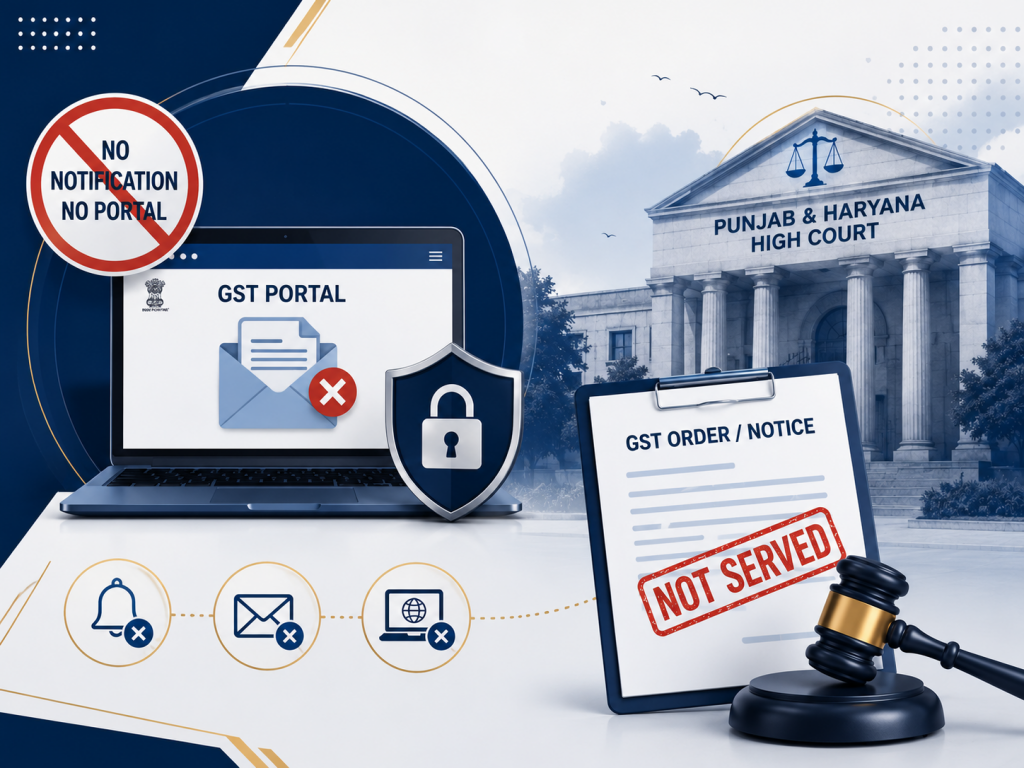
In Luxmi Traders & Ors. v. Union Territory of Chandigarh & Ors. [2026-TIOL-867-HC-P&H-GST], the Division Bench held that merely uploading a notice or order on the GST Common Portal does not amount to valid service under Section 169 of the CGST Act, unless the portal has been specifically notified for that purpose under Section 146.
While several High Courts have previously examined the validity of service through the GST portal, what distinguishes Luxmi Traders is the Court’s approach. Rather than questioning the effectiveness of the portal as a mode of communication, the judgment focuses on a more fundamental statutory issue:
Has the Common Portal ever been notified for the purpose of serving notices and orders?
The Court answered that question in the negative.
The Statutory Framework
The controversy before the Court centred around the interaction between Sections 169 and 146 of the CGST Act.
Section 169 prescribes the various modes by which notices, orders and other statutory communications may be served.
One of those recognised modes is:
- making the notice or order available on the Common Portal under Section 169(1)(d).
At first glance, this appears straightforward.
However, the Court observed that the expression “Common Portal” itself derives its meaning from Section 146, which empowers the Government, on the recommendations of the GST Council, to notify the Common Goods and Services Tax Electronic Portal for specified purposes.
The statutory language therefore became central to the dispute.
Section 146 Requires Notification for Specific Functions
The High Court closely examined Section 146 and observed that the provision does not automatically authorise every conceivable function to be performed through the GST portal.
Instead, the portal may perform only those functions which are:
- specifically notified under Section 146; or
- prescribed by rules made under the Act.
The Court further noted that Section 2(87) defines the expression “prescribed” to mean prescribed by rules.
Consequently, merely because Section 169 refers to service through the Common Portal does not mean that the portal automatically stands authorised for that purpose.
A statutory notification or prescribed rule remains necessary.
What Has Actually Been Notified?
The Court then examined the notifications issued under Section 146.
Three notifications presently notify the GST portal for specific purposes:
- Notification No. 4/2017-Central Tax (19.06.2017) for registration, payment of tax, return filing and settlement of Integrated Tax through www.gst.gov.in.
- Notification No. 9/2018-Central Tax (23.01.2018) notifying the e-Way Bill Portal.
- Notification No. 69/2019-Central Tax (13.12.2019) notifying the e-Invoice Portal.
Significantly, none of these notifications authorises the Common Portal for serving notices, adjudication orders or other statutory communications under Section 169.
That omission proved decisive.
The Court’s Findings
Section 169 Does Not Automatically Activate Portal-Based Service
The Court clarified that although Section 169 recognises service through the Common Portal as one permissible mode, that mode becomes operational only when the portal has been duly notified under Section 146 for that particular statutory purpose.
Since no such notification presently exists, uploading an order on the GST portal alone cannot constitute valid statutory service.
Email Alerts Are Not a Substitute
The Department argued that taxpayers receive email alerts whenever documents are uploaded on the GST portal.
The Court found this insufficient.
The email merely informs the taxpayer that a document has been uploaded.
It does not contain:
- the notice,
- the adjudication order, or
- even a summary of its contents.
The taxpayer must separately log into the portal to discover what has actually been uploaded.
Such an email, therefore, cannot itself qualify as valid service under Section 169(1)(c).
Statutory Procedure Must Be Strictly Followed
The judgment reiterates one of the oldest principles of statutory interpretation:
Where a statute prescribes that something must be done in a particular manner, it must be done in that manner alone.
Since neither the CGST Rules nor any notification under Section 146 presently authorises portal uploads as a mode of statutory service, the Department cannot assume that uploading an order automatically satisfies Section 169.
Recommendations Made by the High Court
Recognising the increasing reliance on digital communication, the Court also suggested several practical improvements that could make electronic service more effective in future.
Among the measures suggested were:
- dedicated dashboard alerts for statutory notices,
- mandatory pop-up notifications upon login,
- OTP-based acknowledgements for important communications,
- automated SMS alerts, and
- a separate dashboard exclusively displaying statutory notices and adjudication orders.
The Court observed that only after such safeguards are introduced can the Common Portal genuinely function as an effective medium for legal communication rather than merely serving as an online repository that taxpayers are expected to monitor continuously.
Section 160: An Important Qualification
The Court also clarified that every defect in service will not automatically invalidate proceedings.
Section 160 of the CGST Act continues to protect proceedings where the taxpayer had actual knowledge of the notice or order and actively participated in the adjudication process.
For example, where a taxpayer:
- accessed the notice,
- filed a reply,
- appeared before the authority, or
- otherwise participated in the proceedings,
it may not subsequently be open to challenge the proceedings solely on technical defects in the mode of service.
Accordingly, the benefit of the judgment primarily assists taxpayers who genuinely remained unaware of the proceedings because the Department relied exclusively upon portal uploads without valid statutory service.
Why the Judgment Matters
The importance of Luxmi Traders extends well beyond the facts of the individual case.
The judgment distinguishes between:
- a portal that exists for administrative convenience, and
- a portal that has been legally authorised to perform a statutory function.
The Court reminds us that statutory powers cannot be exercised merely because technology makes them possible.
Legislative authorisation remains indispensable.
The decision also has practical implications for numerous taxpayers who may have lost valuable appellate remedies because adjudication orders were uploaded silently on the GST portal without any other recognised mode of service.
For such taxpayers, the judgment offers an important legal ground to examine whether limitation periods ever commenced at all.
Conclusion
The decision in Luxmi Traders adds an important chapter to the growing jurisprudence on electronic service under the GST regime.
Rather than questioning digital governance itself, the Punjab & Haryana High Court has emphasised a simpler constitutional principle:
Technology cannot substitute statutory compliance.
If Parliament requires a function to be performed through a notified Common Portal, the executive must first notify that portal for the intended purpose.
Until then, uploading notices or adjudication orders on the GST portal alone cannot create legal consequences merely because the technology permits it.
The judgment therefore serves as an important reminder that digital administration must operate within the framework established by statute, and that convenience can never replace legislative authority.
📎 Attached Article for Detailed Reading
📎 Full Published Version: https://www.centaxonline.com/latest-news-updates/gst/105010000000028745/OPINION
(The author is a practicing advocate, Co-Founder and Legal Head of RB LawCorp.
He specializes in GST law. Suggestions or queries can be directed to
ashsharma@rblawcorp.in. The views expressed in this article are strictly
personal.)


