Author: Ashwarya Sharma, Advocate, Co-Founder & Legal Head, RB LawCorp
Published on: 17/08/2026
1. Introduction
For close to a decade since the Goods and Services Tax regime came into force, taxpayers summoned for interrogation under Section 70 of the CGST Act have often found themselves standing at the edge of a cliff they cannot see. They know an investigation is underway. They know that Section 69 empowers the Commissioner to order their arrest. What they have never known, with any certainty, is whether such an order actually exists, when it was passed, or on what “reasons to believe” it rests.
This information asymmetry, with the Department holding a card it was never obliged to show, has fuelled a decade of anticipatory bail litigation before various High Courts, each attempting to fashion protective interim orders in the absence of any clear statutory duty on the Revenue to disclose its hand.
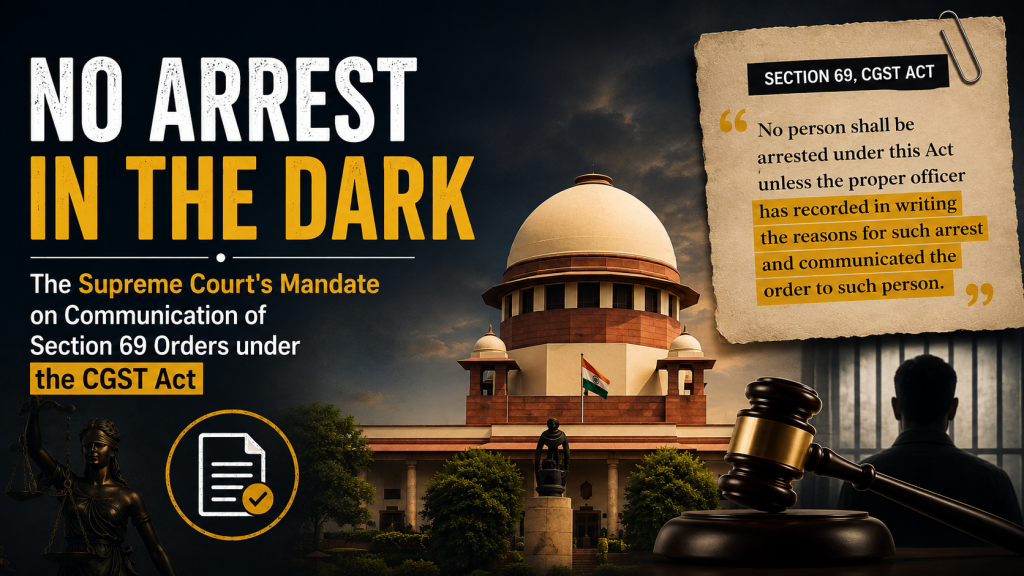
In Union of India v. Sunil Biyani [2026-VIL-78-SC], the Hon’ble Supreme Court has now addressed this gap. While setting aside a protective order passed by the High Court, the Court read into Section 69 of the CGST Act a requirement that has significant implications for GST enforcement: the order of arrest, along with the reasons underlying it, must be communicated to the person concerned before the arrest is effected.
The judgment therefore brings the exercise of the power of arrest under Section 69 into closer alignment with the constitutional safeguards guaranteed under Articles 21 and 22 of the Constitution.
2. Constitutional Framework: Articles 21 and 22
The starting point of the decision, and indeed of any discussion on the power to arrest under a fiscal statute, is Article 21 of the Constitution, which provides that no person shall be deprived of life or personal liberty except according to procedure established by law.
Article 22(1) provides an additional safeguard in cases of arrest. The arrested person must be informed, “as soon as may be”, of the grounds for such arrest and must not be denied the right to consult and be defended by a legal practitioner of their choice.
These constitutional safeguards assume particular significance in the context of Section 69 of the CGST Act. The provision empowers the Commissioner to order the arrest of a person where he has “reasons to believe” that such person has committed an offence specified under Section 132 of the CGST Act.
Unlike the ordinary criminal process, the exercise of this power does not necessarily begin with an FIR, nor does it require prior judicial sanction. The requirement that the Commissioner possess and record “reasons to believe” therefore becomes a critical internal safeguard against arbitrary deprivation of personal liberty.
The question before the Supreme Court was whether this safeguard could remain entirely within the Department’s records or whether the person facing arrest must be informed of the order and the reasons supporting it.
3. Factual Background
The respondent had applied for pre-arrest bail before the Hon’ble Bombay High Court in the backdrop of an ongoing investigation by the DGGI, Mumbai Zonal Unit, concerning alleged wrongful availment and passing on of Input Tax Credit.
During the investigation, the Department had issued multiple summons under Section 70 of the CGST Act. The respondent approached the Sessions Court, Mumbai, seeking anticipatory bail after his apprehension of arrest.
The Sessions Court rejected the application, following which the respondent approached the Bombay High Court.
During the proceedings before the High Court, the Department submitted that no order under Section 69 had been passed and that the investigation was still at an early stage, with material facts continuing to be verified.
The High Court consequently rejected the anticipatory bail application on the ground that, in the absence of an order under Section 69, there could be no immediate apprehension of arrest.
However, despite rejecting the application, the High Court granted protection from arrest for one week from the date on which any order under Section 69 was communicated to the respondent.
The matter thereafter reached the Supreme Court.
4. Issues Before the Supreme Court
Two principal questions arose for consideration:
First, whether the High Court, having held that an anticipatory bail application was not maintainable in the absence of an order under Section 69, could nevertheless grant protection from arrest in respect of any future order.
Second, and more significantly, whether an order passed by the Commissioner under Section 69 of the CGST Act must be communicated to the person against whom it is passed before such person can be arrested pursuant to that order.
5. Discussion and Findings of the Supreme Court
5.1 Summons Under Section 70 Do Not, By Themselves, Make a Person an Accused
The Supreme Court first reaffirmed the settled position that the mere issuance of summons under Section 70 of the CGST Act does not, by itself, make the person summoned an accused.
Relying upon its earlier decision in Radhika Agarwal v. Union of India [2025-VIL-11-SC], the Court reiterated that a summons issued during an investigation cannot automatically be equated with the initiation of criminal prosecution against the person summoned.
Since the respondent, at the stage when he approached the High Court, had only been summoned and no order under Section 69 had been passed, the Supreme Court found no basis to interfere with the rejection of the anticipatory bail application on this ground.
5.2 Interim Relief Cannot Survive Where the Main Proceeding Is Not Maintainable
The Court then examined the legality of the protection granted by the Bombay High Court.
The Supreme Court referred to the five-judge Bench judgment in State of Orissa v. Madan Gopal Rungta (1951 SCC 1024), which established the principle that interim relief cannot be granted independently where the main proceeding itself is not maintainable.
The rationale is straightforward: interim relief is ancillary and subordinate to the principal relief and cannot exist in isolation.
The Court also referred to Hema Mishra v. State of U.P. ((2014) 4 SCC 453), where the Supreme Court had applied the same principle in the context of criminal proceedings. Once a petition seeking substantive relief is dismissed, further protection against arrest cannot ordinarily be continued as an independent form of relief.
Applying this principle, the Supreme Court held that once the Bombay High Court had rejected the anticipatory bail application, it could not simultaneously grant protection from arrest for a future period upon the possible passing of an order under Section 69.
The protective portion of the High Court’s order was therefore set aside.
5.3 Must a Section 69 Order Be Communicated Before Arrest?
The more significant question concerned the communication of the Section 69 order.
The Court noted the apparent difficulty faced by a person seeking anticipatory bail. An order under Section 69 is the essential basis for apprehending arrest under the provision. Yet, if the Department is permitted to pass such an order without communicating it to the person concerned, the person may have no means of knowing that the order exists until the moment of arrest.
This creates an obvious legal paradox.
A person cannot effectively seek anticipatory bail without an order under Section 69, but if the existence of that order is never communicated, the person may only discover it when the arrest is actually carried out.
The Supreme Court accepted this concern and held that the order passed under Section 69 must be communicated to the person before arrest.
5.4 Communication Enables Meaningful Judicial Review
The significance of communication goes beyond merely providing information about a proposed arrest.
The Court recognised that the order and the reasons underlying the Commissioner’s satisfaction are capable of being subjected to judicial scrutiny.
The requirement of “reasons to believe” under Section 69 cannot therefore remain an entirely internal satisfaction incapable of meaningful examination.
Communication of the order gives the affected person an opportunity to approach the appropriate judicial forum and challenge the basis of the proposed arrest.
In this sense, communication is not a concession to the person under investigation. It is a necessary component of effective judicial review and procedural fairness where personal liberty is at stake.
The judgment therefore strengthens the practical significance of Articles 21 and 22 in the context of GST investigations.
5.5 Mode of Communication: Electronic Communication Is Permissible
The Supreme Court also considered the practical mechanism through which such an order may be communicated.
The Court referred to Rule 8 of the CGST Rules, 2017, which requires a person seeking GST registration to furnish an email address and mobile number.
In this context, the Court recognised that communication of the Section 69 order can take place through electronic means, in addition to other legally permissible modes of service.
The objective is clear: the person concerned should receive timely information regarding the order so that any available legal remedy can be pursued without unnecessary delay.
The requirement of communication therefore ensures that the existence of the arrest order is not kept concealed until the point at which personal liberty is actually taken away.
6. Significance of the Judgment
The decision in Sunil Biyani has broader implications for GST enforcement.
The “reasons to believe” requirement under Section 69 is not merely an internal formality. It is a safeguard accompanying the extraordinary power to deprive a person of personal liberty.
By requiring communication of the arrest order before arrest, the Supreme Court has effectively made that safeguard more transparent and capable of judicial scrutiny.
The judgment also provides greater clarity to taxpayers who find themselves under investigation and are concerned about the possibility of arrest. A person cannot be expected to approach the court merely on the basis of a summons and speculative apprehension where no Section 69 order exists.
At the same time, once such an order is passed and communicated, the person concerned has a meaningful basis to seek appropriate legal protection.
7. Implications for GST Practitioners
For practitioners dealing with GST investigations, the judgment provides an important framework.
First, a summons under Section 70 should not automatically be treated as an arrest order or as conclusive evidence that the person summoned has become an accused.
Second, where a Section 69 order has actually been passed, its communication assumes critical importance.
Third, once the order is communicated, the person concerned can examine the basis on which the Commissioner has recorded the requisite “reasons to believe” and consider the appropriate judicial remedy.
Finally, the judgment reinforces the proposition that personal liberty cannot be subjected to an opaque enforcement process merely because the underlying investigation concerns fiscal offences.
8. Conclusion
Union of India v. Sunil Biyani is likely to be remembered for more than the narrow question of the interim protection granted by the Bombay High Court.
Its larger significance lies in the structural correction it brings to the exercise of arrest powers under the CGST Act.
For years, the “reasons to believe” requirement under Section 69 could operate largely as an internal safeguard, with the person facing investigation having limited visibility into whether an arrest order had actually been passed or what had prompted the Commissioner’s satisfaction.
The Supreme Court has now made the position substantially clearer: an order under Section 69 must be communicated to the person concerned before arrest.
The consequence is important. The power of arrest remains available to the Department, but the exercise of that power must operate within a framework of transparency, procedural fairness and meaningful judicial review.
For practitioners, the judgment provides an important basis to examine the legality of a Section 69 order once it has been issued and communicated.
Ultimately, Sunil Biyani protects a principle larger than any individual taxpayer: a person should not have to discover, at the moment of arrest, that the State had already decided to take away his liberty.
📎 Attached Article for Detailed Reading
📎 Full Published Version: https://vilgst.com/showiframe?V1Zaa1VsQlJQVDA9=TVRrM05BPT0=&page=articles
(The author is a practicing advocate, Co-Founder and Legal Head of RB LawCorp.
He specializes in GST law. Suggestions or queries can be directed to
ashsharma@rblawcorp.in. The views expressed in this article are strictly
personal.)


